CASE STUDIES · INGENIO (KEEN)
Keen: User Acquisition
Optimized the payment flow to reduce drop-off and improve user conversion
Funnel analytics revealed a clear drop-off at the payment step, the exact moment new users needed to commit. I combined Mixpanel data with moderated user interviews to diagnose the friction, then redesigned the mobile payment flow to improve transparency and reduce steps, lifting retention at that stage by 15%.
Context
01 · THE PROBLEM
Keen is a wellness platform that connects users with psychics and spiritual advisors; tarot readers, astrologers, mediums, through live, pay-per-minute sessions. New users are offered promotional minutes at a reduced rate or free, designed to lower the barrier to a first interaction. My role sat within the Acquisition team. The objective was clear: guide new users through the onboarding journey until they completed their first billed minute.
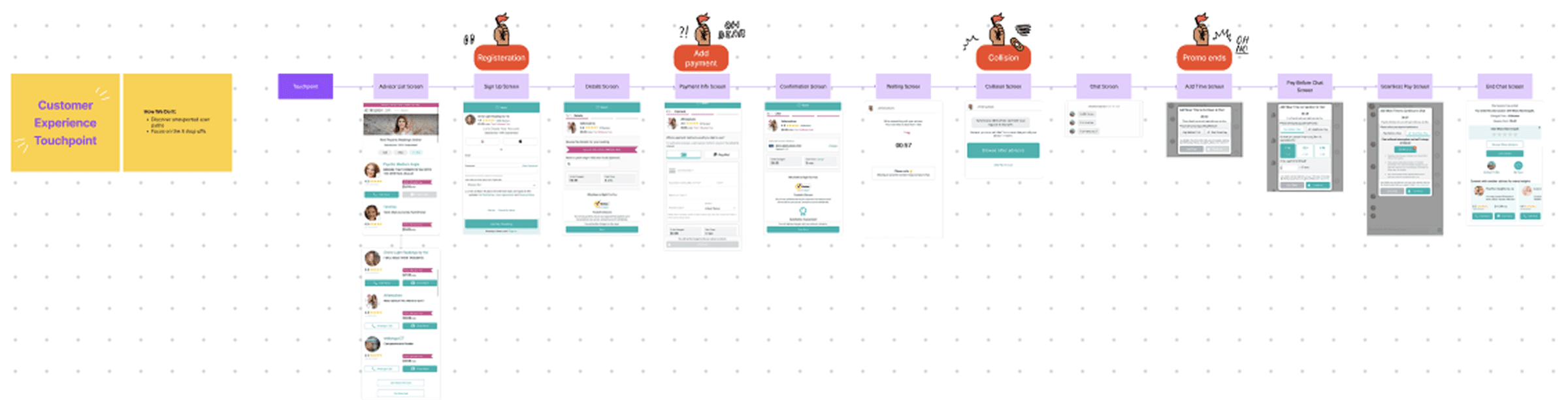
The data told us we had a problem before any user ever said a word. Using Mixpanel and Hotjar, I analyzed the onboarding funnel and mapped where users were abandoning the process. The drop-off was not spread across the flow, it concentrated at a single point: the payment step. A significant share of users reached the moment of entering payment information and did not complete it. They stopped exactly where the product needed them to move forward.
That pattern is not random. It is a signal.
What I did
02 · THE PROCESS
2.1 Research
To understand what was driving the abandonment, I ran a focused research initiative combining the quantitative signal from analytics with direct qualitative investigation.
This project also served as the pilot for a research operations framework I was developing for the team. An atomic research methodology built around Dovetail. Rather than producing a one-off presentation of findings, I structured the work from the start around a tagging and synthesis system: observations tagged at the atomic level, patterns surfaced through the platform, and insights organized in a way that could be queried by other designers and product teams on future projects.
The goal was to move the team away from insight decks that lived in someone's Drive folder and toward a living research repository. One that accumulated knowledge rather than resetting it with every new study.
2.1.1 USER INTERVIEWS
I conducted 10 moderated user interviews across two participant groups:
(5) Recent platform users: people within their first month on Keen, who had already navigated the onboarding flow
(5) External participants: people unfamiliar with the platform, encountering it for the first time during the session
Sessions focused on three areas: clarity of the payment process, perceived trust and transparency, and emotional responses during the flow.
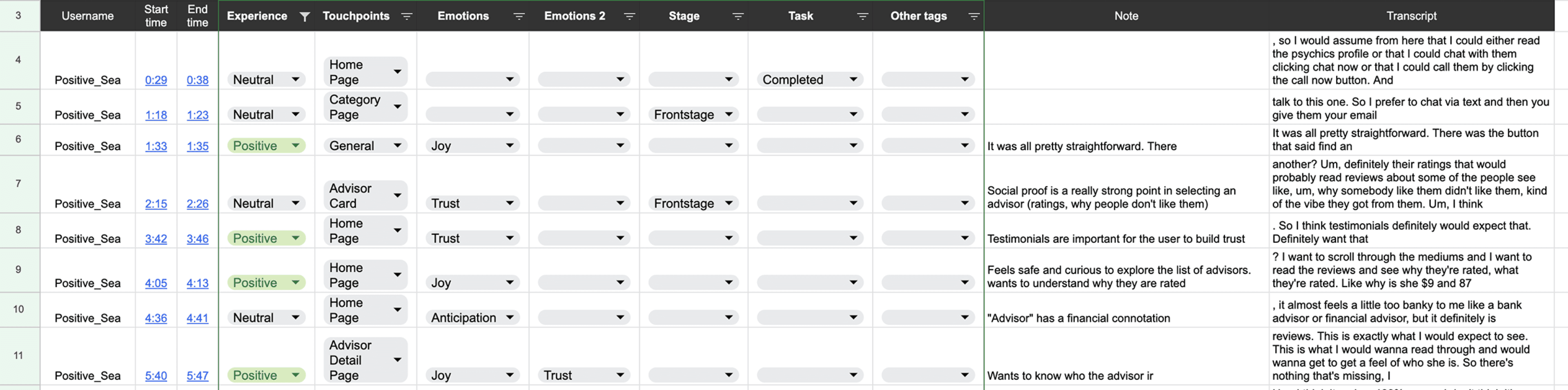
Atomic Research
Transforms individual sessions into shared organizational knowledge. Every tagged observation feeds a repository that outlives any single project.
2.1.2 EXISTING USERS INSIGHTS
The first group were recent platform users. People within their first month on Keen who had already completed the payment process. Recruiting users who had successfully made it through the flow was a deliberate choice. Their perspective gave us something drop-off data alone cannot: an account of what the experience actually felt like from the inside, including the friction points they pushed through rather than abandoned.
01.
Prior experience relevance
Several of these users had prior experience with similar platforms. That familiarity acted as a buffer. They already had a mental model for how pay-per-minute services work, which made the payment process feel manageable even when it was imperfect.
02.
Many Steps
The payment flow felt longer than it needed to be. Some screens were dense with information, requiring users to scroll to find key actions that should have been immediately visible. The experience asked for more cognitive effort than the moment warranted.
03.
Recharge Interruption
Once promotional minutes ran out, a pop-up appeared mid-conversation prompting users to add funds. The abruptness of that moment, created friction and broke the emotional continuity of the session.
04.
Advisor Availability
In some cases, users completed the payment process only to find the advisor they had selected was no longer available, causing a set back of intention to pursue the process again, and creating friction on their very first interaction.
2.1.3 EXTERNAL USERS INSIGHTS
The second group had never used Keen. Recruiting participants completely unfamiliar with the platform gave us a view of the flow with no prior context, the closest approximation to a genuine first-time user we could observe in a controlled setting.
01.
Decision fatigue
By the time a new user reaches the payment step, they have already done significant work. They have discovered the platform, understood the service model, browsed advisor profiles, and selected someone they felt a connection with. When they finally reach payment, they are not approaching it as a neutral transaction, they are trying to close the distance between themselves and a conversation they have already decided they want.
02.
More Steps?
At that moment, every additional step in the payment flow works against the momentum they have built. These users did not find the flow incomprehensible; it reminded them of familiar e-commerce patterns. But they wanted it to be faster. The investment they had already made meant their tolerance for friction was lower, not higher. They had already decided. The flow needed to get out of the way.
03.
What happens next?
This group also surfaced uncertainty about what would happen after the promotional minutes ended. They did not fully understand how billing would continue, what the transition would feel like, or how to make the most of the time they had been offered. That uncertainty did not necessarily prevent them from completing payment; but it created hesitation. And hesitation at a payment step has a cost.
2.2 Design Strategy
The two groups pointed to the same underlying problem from different angles. Existing users had navigated the friction because their prior experience gave them context that the platform itself had not provided. External users had less tolerance for that friction precisely because their motivation was high and their familiarity was zero.
The redesign needed to do three things:
01.
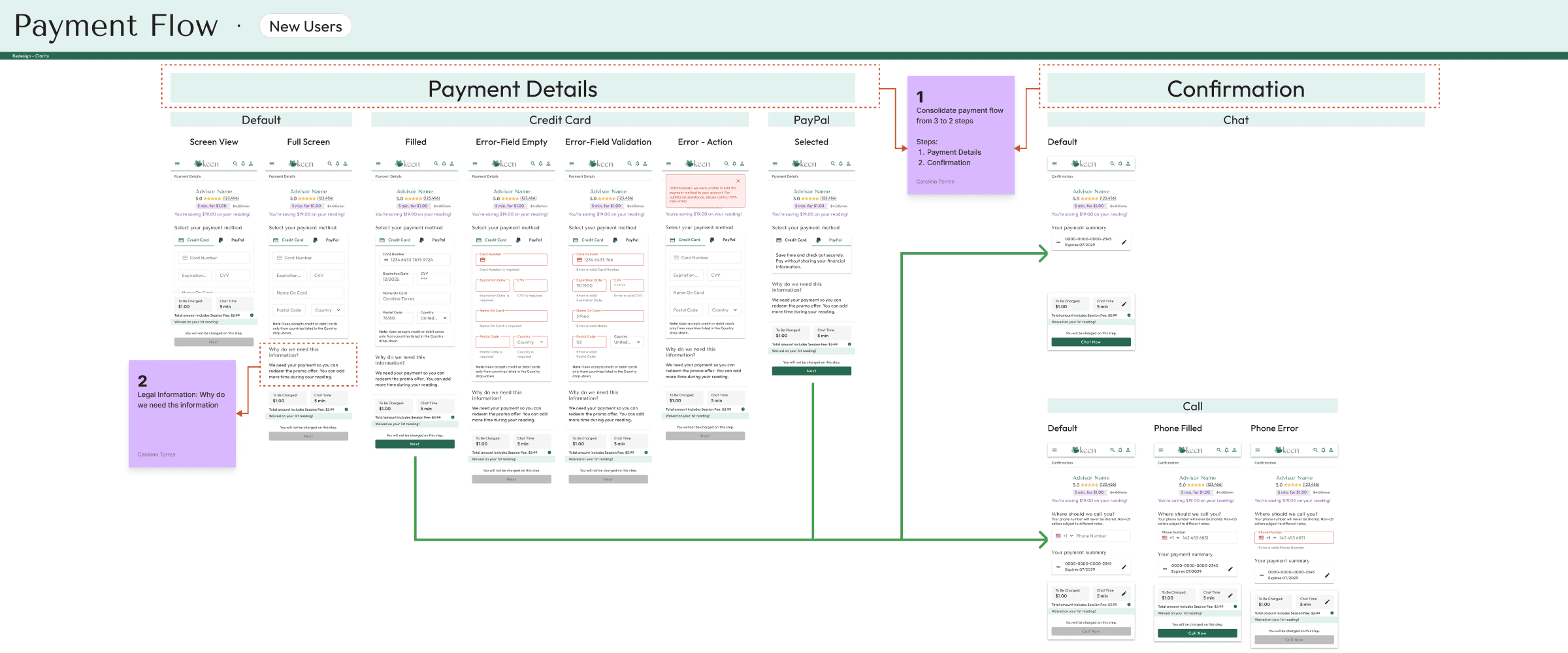
The flow moved from 4–5 steps to 2–3. Every step removed is a decision point eliminated, and at this stage of the funnel, decision points are the enemy.
02.
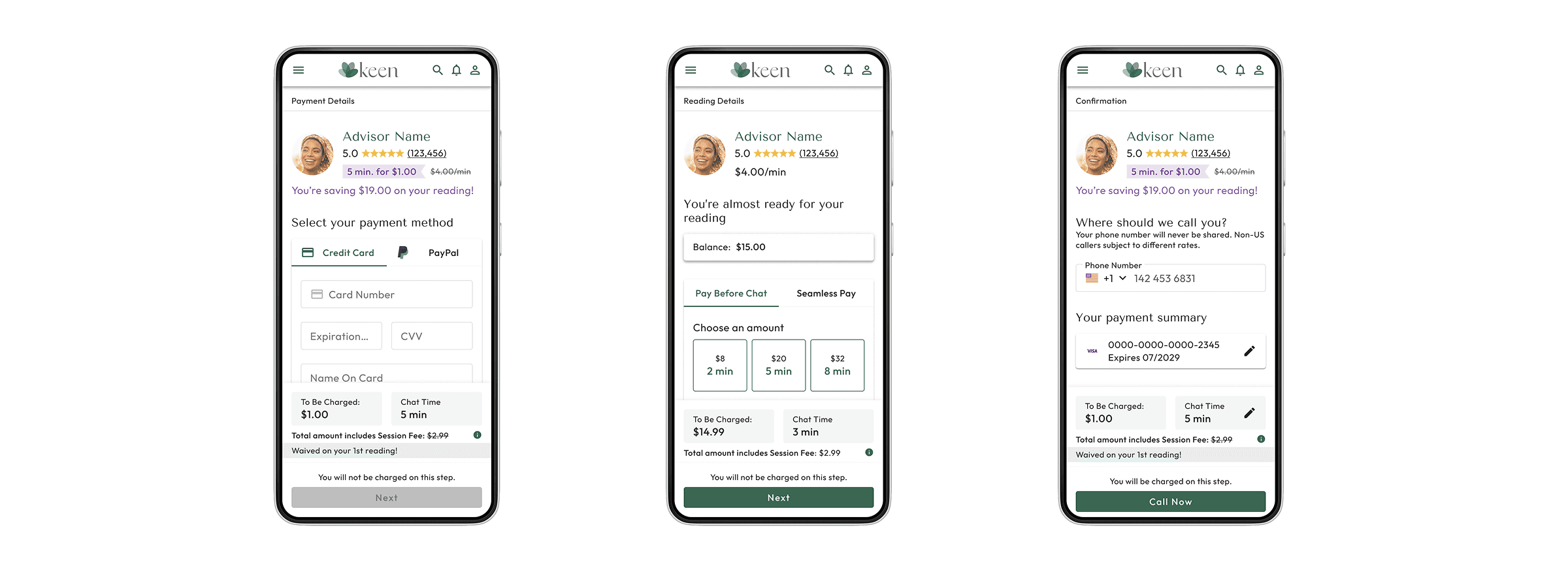
Surface clear, plain-language explanations of how minutes are counted, how charges work, and what happens when promotional time ends. This was not just a clarity improvement, it was an anxiety intervention. Users who understood what would happen next were less likely to hesitate before committing.
03.
Rather than waiting for the recharge moment to explain how billing continues, we moved that communication earlier; into the payment flow itself. Users who understood the session model before they committed were better prepared for what came after. The goal was to make the transition from promotional minutes to paid time feel expected rather than disruptive.
2.3 Design Execution
The redesign focused entirely on the mobile experience. Keen's users access the platform primarily through mobile browsers and the native app, which meant every decision, hierarchy, form structure, tap targets, microcopy; was evaluated in that context.
Working in Figma, I redesigned the payment flow with a streamlined step structure, clearer visual hierarchy, a simplified form architecture, and revised microcopy that explained billing behavior in direct, human language.
I brought designs into weekly review sessions with other designers on the team to pressure-test decisions, collect alternative perspectives, and refine details before moving toward handoff. Cross-functional collaboration was essential to the final quality of the work. With the Marketing team, I aligned on all copy and microcopy within the flow; ensuring the language matched Keen's brand voice while remaining emotionally clear for a user mid-decision. With Legal and Compliance, I reviewed every piece of billing-related language to ensure it was not only user-friendly but technically precise. Payment flows carry legal weight.
Clarity and accuracy are not in tension here, they are the same requirement.
What I achieve
03 · THE OUTCOMES
3.1 RESULTS
More users completed their first paid interaction. That translates directly to revenue, and to users reaching the moment the product was designed to deliver.
The advisor collision issue and the recharge interruption experience were both formally documented and handed off as separate workstreams. Research that surfaces problems outside the project's scope is not wasted; it seeds the next one.
3.2 SHAPING DESIGN STRATEGY
This was the first project where the atomic research framework was put into practice. Using Dovetail as the central research infrastructure, with a structured tagging system, unified insight templates, and a repository built for reuse; the team moved away from producing findings as presentations and toward producing findings as shared organizational knowledge. That shift started here. The framework scaled gradually after this pilot, eventually being adopted across the Acquisition, Retention, and Growth teams, eliminating research duplication across concurrent projects and enabling longitudinal insight tracking over time.
3.3 MY LEARNINGS
Drop-off is rarely about one thing. In this case, the friction was structural (too many steps), informational (unclear billing), and emotional (anxiety about what comes next). Existing users had absorbed that friction through prior experience. New users had no such buffer and their momentum made them less forgiving of it, not more.
What analytics surfaces is where the problem is. Research reveals why it exists. The job of design is to resolve both, and to make sure what you learn does not disappear when the project closes.